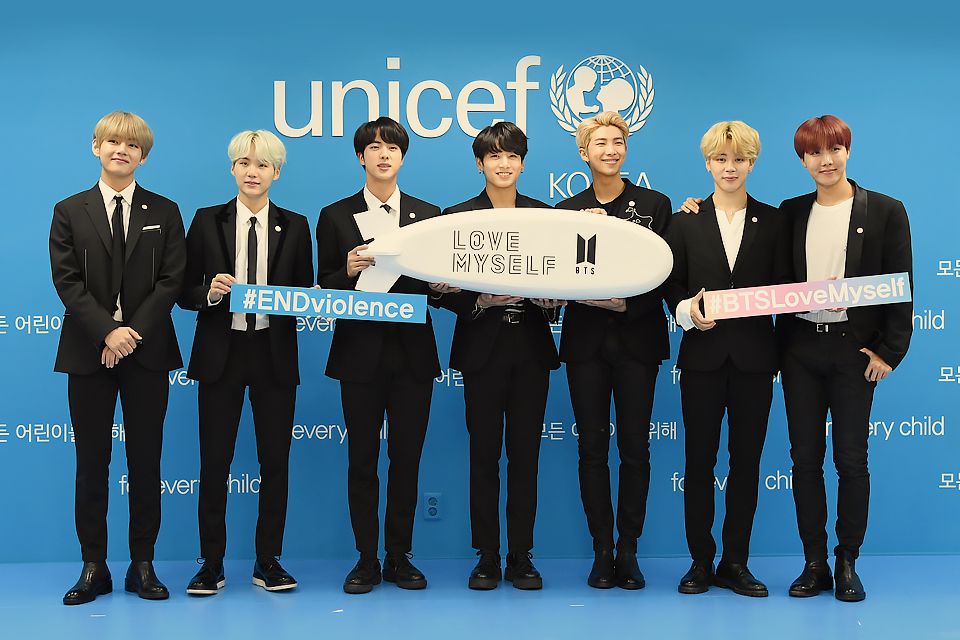
The introduction of social and participatory media has facilitated changes in the music industry, especially in relation to the amplified reach towards the audience. The skills and literacies required to be a musician are evolving, and so are the marketing strategies in the profession itself. Developed social networking sites enable artists and companies to communicate with the audiences more effectively. This case study aims at analyzing the changing nature of the relationship between professional musicians and audiences by discussing the case of Billboard’s Top Social Artist of 2017 & 2018, BTS – a 7 member Korean band who debuted under BigHit Entertainment.


Although K-Pop is a niche genre of music, BTS rose to success in the mainstream American Music Industry due to their unique marketing strategies which differ from other famous Kpop groups. “Their label was the first to embrace the messy, unvarnished nature of social media, allowing the band to reveal more of their real personalities.” (Haynes 2017). According to Raisa Brunner, BTS has “at least 50 million followers across English-language social media platforms.” (Time Staff 2018). They are among the 25 Most Influential People on the Internet.
The Web 2.0 brought new distribution methods to broadcast content, through networked technologies to networked publics. Boyd (2010) mentions how Social Media affordances allow people to “connect to one another across great distances and engage with asynchronously produced content over extended periods.” Two of the affordances of Boyd’s Networked Publics were Scalability- “possibility of tremendous visibility” and Searchability- accessible online content via search. Both these affordances worked in BTS’ Favour. Translations provided by youtuber Justdavid (2018) explain how BTS manage their twitter account and use multiple platforms to upload creative content. According to Hookham (2018), BTS’ heavy reliance on Twitter and YouTube to output self-promotional content online, “contradicted the norms of the industry since K-pop idols typically use Korean news channels and TV shows to make a name for themselves.” Boyd (2010) states that “Content and expressions contributed to networked publics is persistent and replicable by default, the possibility of acts being scaled, searchable, and thus viewed is heightened.”
A key feature in their online marketing strategy is the range of content BTS posts, which is a good example of Crossmedia, for engaging audiences. (Graham 2019, 18). There’s something for everyone. Music produced by the members is uploaded on paid platforms like Spotify while free music and mixtapes are posted through SoundCloud. The music videos are uploaded on the company’s main channel iBighit. The company also manages BTS’ personal YouTube account BangtanTV (2019), which features videos of the members’ daily lives such as short ‘Bangtan Bombs’, Episodes, talk shows, vlogs and self-edited videos. This account created in 2012, has garnered 16.5 million subscribers and 2.3 Billion views to date. (BangtanTV 2019). In 2018 they filmed and uploaded a Documentary series ‘Burn the Stage’ on YouTube Red showcasing the members’ hardships and experiences while on tour. “Streaming platforms like Korea’s ‘Vlive’ give fans intimate access to the members as they do mundane things like eating and sitting in their hotel rooms after a performance.” (MTV News 2018). Other than going live to talk to fans, reality series like Bon Voyage and Run BTS!, “invite audiences to laugh along as they do random challenges and travel the world.” This content is posted as weekly episodes during tours or holiday period. This way, people all around the world get to virtually interact with BTS even when they are inactive. Profits of posting video content and advertisement driven revenue add to the financial growth of BigHit and BTS, while past musicians were dependent only upon album and concert sales. Adding to the free content available to stream online, BigHit urges fans to pay for premium subscriptions on Vlive+ & YouTube Red for more Behind the Scenes content.
All this content is continuously pumped out and it’s a complex, time-consuming process compared to traditional advertising. However, it helps BTS create their Brand identity as explained by Marwick (2013), “Social media applications encourage people to compete for social benefits by gaining visibility and attention. To boost social status, professionals adopt self-consciously constructed personas and market themselves, like brands or celebrities, to an audience or fan base.” This idea of a highly monitored, curated and performed social-self clashes with the concepts of Authenticity and originality, hence BigHit promotes BTS to express their true selves via social media and allows them to freely ‘lifestream’. “BTS has opened up their personalities on the internet long before they blew up.” (akidearest 2018). She further explains how the agencies have always been a wall between the artists and fans, but BTS’ informal approach helps fans relate to them as people. The celebrity lifestyle has always been advertised as luxurious and glamourous. However akidearest (2018) says that showing one’s true personality can make celebrities appear more human. “It’s about our daily life as a band on tour — and also as a group of silly friends who make fun of one another backstage.” Says RM, the leader of BTS in an interview with Time (Brunner 2017). An unavoidable cost for this is the members loss of privacy as well as the blurring of lines in their personal and public selves. According to Papacharissi & Gibson, “Sociality has always required some (voluntary) abandonment of privacy. In order to become social, we must give up some of our private time and space so as to share it with others”. (Graham 2019, 39).
“New Media Entertainment has to value audiences as demanding contributors.“ (Graham 2019, 21). BTS’ close interactions with their global fanbase called ‘ARMY’, mainly through Twitter, Vlive and YouTube, has earned them the most powerful and diverse fanbase in the world. (MTV News 2018). Elements of Crowdsourcing and Produsage are noticeable in this worldwide participatory fandom. “As active participants, fans often appropriate corporate-generated imagery, and then embellish or transform it with personal artistic expressions” (Shefrin 2004, 273) like art, creative fiction, clothing etc. User generated content takes up a vast majority of this public sphere. “Fan translators translate content from Korean to other languages, for free in their own time.” (MTV News 2018). Often, these videos are uploaded within a few hours of the release of new content, to overcome language barriers. Dedicated fans promote BTS via different means, whether Twitter campaigns and petitions to get radio spins for BTS Songs or music streaming parties on different platforms. “Participatory fandom is marked by a sustained emotional and physical engagement with a particular narrative universe—an engagement that visualizes a non-commercial, shared ownership with the media company that holds the commercial, legal property rights.” (Shefrin 2004, 273). BTS’ creative team works to incorporate storylike elements within each music video and album, hence their fandom works collectively to decode all these messages and clues. There are a plethora of theories on Twitter and explanation videos on YouTube about the storylines. With the addition of their new webtoon ‘save me’, BTS also becomes ‘Transmedia’ (Graham 2019, 19) oriented as the storyline flows from one platform to the other, ensuring an active audience. Increasing content, amplifies the reach of the culture. However copyright issues often arise as a result of illegal uploads on secondary channels where people try to monetize BTS’ brand illegally. Sherin (2004, 273) remarks, “participatory fandom is the enemy of media companies.”
The worldwide popularity of BTS, proves that social media provides the global outreach and lays the groundwork essential for the success of niche music genres like Kpop. The members of BTS not only need to excel in dancing, singing and rapping, but they also need to be excellent entertainers in order to engage audiences with their content. Social Media Management is also a highly sought after skill. It can be concluded that adapting to the emerging new media platforms can make an artist popular. It’s apparent that BTS are selling their brand identity as idols, just as much as their music.
References:
Akidearest. 2018. “Does BTS Deserve Their Success?” YouTube video, August 30, 2018. https://www.youtube.com/watch?v=QqPqHTMpBm8
BANGTANTV. 2019. “BTS Official YouTube Channel.” Accessed March, 2019. https://www.youtube.com/user/BANGTANTV/videos
Boyd, Danah. 2010. “Social Network Sites as Networked Publics: Affordances, Dynamics, and Implications.” Networked Self: Identity, Community, and Culture on Social Network Sites. 39-58. http://www.danah.org/papers/2010/SNSasNetworkedPublics.pdf
Brunner, Raisa. 2017. “Rap Monster of Breakout K-Pop Band BTS on Fans, Fame and Viral Popularity.” Last modified June 28, 2017. http://time.com/4833807/rap-monster-bts-interview/
Google Trends. 2019. “Comparison of the Worldwide Web searches in the top 3 kpop male groups.” Accessed on March 24, 2019. https://trends.google.com/trends/explore?date=2015-09-01%202019-03-24&q=%2Fm%2F0w68qx3,%2Fm%2F0h_dkd6,%2Fm%2F049g_gp
Graham, Timothy. 2019. “KCB206 Social Media, Self and Society: Week 3 Lectorial slides.” Accessed March 24, 2019. 39. https://blackboard.qut.edu.au/bbcswebdav/pid-7846361-dt-content-rid-23079970_1/xid-23079970_1
Graham, Timothy. 2019. “KCB206 Social Media, Self and Society: Week 5 Lectorial slides.” 18-21. Accessed March 24, 2019. https://blackboard.qut.edu.au/bbcswebdav/pid-7846363-dt-content-rid-23079973_1/xid-23079973_1
Haynes, Gavin. 2017. “Why BTS are the K-pop kings of social media.” Last modified May 26, 2017. https://www.theguardian.com/music/shortcuts/2017/may/23/bts-k-pop-kings-social-media
Hookham, Jade. 2018. “BTS Is A Social Media Success Story.” Last modified May 11, 2018. https://studybreaks.com/culture/bts-social-media/
Justdavid. 2018. “KOREAN MEDIA BTS SUCCESS ANALYZATION [BIG3, Psy, The Beatles, ARMY].” YouTube video, May 29, 2018. https://www.youtube.com/watch?v=eEoZMkpBo88
Marwick, A. 2013. “Introduction.” In Status Update: Celebrity, Publicity and Branding in the Digital Age, 1-19. New Haven, CT: Yale University Press. https://blackboard.qut.edu.au/bbcswebdav/pid-7846327-dt-content-rid-23079996_1/xid-23079996_1
MTV News. 2018. “BTS ARMY: Inside the World’s most Powerful Fandom | MTV News.” YouTube video, November 16, 2018. https://www.youtube.com/watch?v=ErsjsFpIz4s
PopCandy. 2017. “[Bloomberg] BTS gets tweeted about more than Trump and Justin Bieber combined.” Last modified December 17, 2017. https://www.allkpop.com/forum/threads/bloomberg-bts-gets-tweeted-about-more-than-trump-and-justin-bieber-combined.127676/
Quinn, K. And Z. Papacharissi. (2018) “Our networked selves: Personal connection and relational maintenance in social media use.” In The SAGE Handbook of Social Media, edited by J. Burgess, A. Marwick, and T. Poell, 353-371. London: SAGE. https://blackboard.qut.edu.au/bbcswebdav/pid-7846338-dt-content-rid-23080000_1/xid-23080000_1
Shefrin, Elana. 2004. “Lord of the Rings, Star Wars, and Participatory Fandom: Mapping New Congruencies Between the Internet and Media Entertainment Culture.” Critical Studies in Media Communication 21 (3): 261-281. http://civicpaths.net/groupblog/wp-content/uploads/2010/07/Lord-of-the-Rings-Star-Wars-and-Participatory-Fandom.pdf
Time Staff. 2018. “The 25 Most Influential People on the Internet.” Last modified June 30, 2018. http://time.com/5324130/most-influential-internet/
Leave a Reply